

California Workers’ Comp Class Codes for Contractors: The Complete Guide
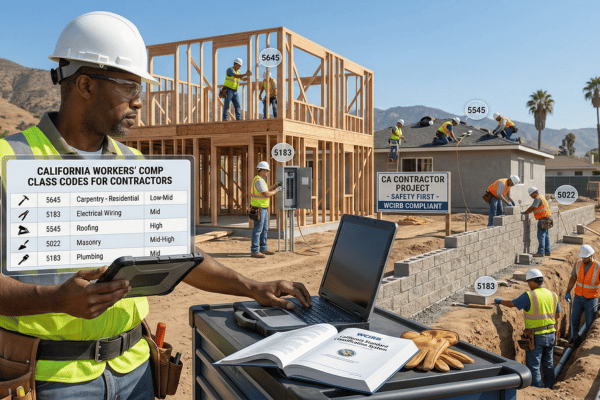
California’s WCIRB class system for contractors, how it differs from NCCI, and which codes apply to each trade.

Written by Curran Clark
Co-Founder & Licensed Insurance Producer

Written by Charlie Hughes
Co-Founder & Licensed Insurance Producer
If you’re a California contractor, your workers’ compensation class code is one of the biggest factors in what you pay for coverage. Get the wrong code on your policy and you could be overpaying by thousands, or worse, get hit with a surprise bill at audit time. (See our guide for a broader overview of how workers’ comp works for contractors.)
California uses its own classification system through the Workers’ Compensation Insurance Rating Bureau (WCIRB), which is separate from the NCCI system used in most other states. That means the codes and rules here are unique to California, and contractors operating in the state need to understand how they work.
This guide covers the most common class codes assigned to California contractors, including which trades they apply to, how dual wage thresholds affect your rate, and what to watch out for. For the official source, you can search class codes directly on the WCIRB Classification Search.
How California workers’ comp class codes work
Every California employer with employees needs workers’ comp insurance, and every employee on that policy gets assigned a class code. The WCIRB maintains about 700 standard classifications, and each one carries a pure premium rate expressed as a cost per $100 of payroll.
Higher-risk trades like roofing and tree service have significantly higher rates than low-risk office work. A roofer might cost $15 to $17+ per $100 in payroll to insure, while clerical staff might cost less than $1 per $100.
Your class code is assigned based on the actual work your employees perform, not just your license type or what you call yourself. A general contractor who does hands-on framing will be classified differently than one who only manages subcontractors from an office. For a breakdown of how class codes affect what you pay, see our artisan and specialty contractor insurance costs.
California’s dual wage system
One feature that makes California unique is the dual wage classification system. For many construction trades, the WCIRB splits class codes into “low wage” and “high wage” versions based on an hourly pay threshold.
The idea is straightforward: higher-paid workers tend to be more experienced, have fewer injuries, and cost less to insure. If you’re paying your electricians $40/hour, your rate per $100 of payroll will be lower than if you’re paying them $28/hour.
Each trade has its own threshold, and these are updated periodically by the WCIRB. For policies effective September 1, 2025 and later, the thresholds remain the same as 2024. You need to maintain detailed payroll records showing each employee’s hourly wage and hours worked to qualify for the high-wage rate.
If you can’t prove the wage at audit, you’ll get charged the low-wage (higher) rate.
Office and general contractor codes
These standard codes apply across all industries but are particularly relevant for construction companies with office staff and general contracting operations.
8810 – Clerical Office Employees
This code covers employees who work exclusively in an office setting performing administrative duties. Think data entry, filing, answering phones, bookkeeping, processing invoices, and general office management. Receptionists, office managers, bookkeepers, and administrative assistants in construction companies typically fall here.
The key word is “exclusively.” If your office manager occasionally visits a job site to drop off materials or check on a project, they may not qualify for 8810. Employees classified here should have no exposure to job site hazards. This is one of the lowest-rate class codes available, so it’s worth keeping your office staff properly separated from field operations.
5610 – Subcontracted Work
This is a significant code for general contractors and construction managers who subcontract 50% or more of their work to properly insured subcontractors. Rather than being classified under a specific trade, GCs who primarily coordinate and manage subs can use this code.
The “properly insured” part matters. You need certificates of insurance from every sub, and if a sub’s coverage lapses or they don’t carry adequate limits, their payroll exposure could end up on your policy. Many construction managers, design-build firms, and GC operations that focus on project management rather than self-performing work use this code. For more on what GCs typically pay, see our general contractor insurance cost guide.
Carpentry
If you run a carpentry business, these are the codes you’ll see on your policy. For a deeper look at coverage and costs, check out our workers’ compensation guide for carpenters.
5403 – Carpentry, low wage (under $41/hr)
Covers carpenters earning less than $41 per hour working on commercial buildings or residential structures over three stories. This includes rough framing, trim carpentry, form building, and general carpentry on larger-scale projects. Entry-level carpenters, apprentices, and newer journeymen on commercial job sites typically fall here.
5432 – Carpentry, high wage ($41/hr and above)
Same work as 5403 but for carpenters earning $41 per hour or more. Experienced journeymen, lead carpenters, and foremen doing complex commercial framing or finish work are common examples. The higher wage threshold reflects the lower loss history associated with experienced tradespeople.
Concrete work
Concrete contractors deal with several class codes depending on the type of work and project size. For full coverage details, see our concrete contractor insurance guide.
5201(1) – Concrete sidewalks, low wage (under $33/hr)
For workers earning under $33 per hour pouring and finishing sidewalks, driveways, patios, and smaller concrete slabs. Residential concrete flatwork contractors and entry-level finishers doing walkways and driveway pours typically use this code.
5205(1) – Concrete sidewalks, high wage ($33/hr and above)
Same flatwork scope but for workers earning $33 per hour or more. Experienced concrete finishers, foremen running flatwork crews, and skilled decorative concrete specialists on driveway and sidewalk projects fall here.
5201(2) – Concrete work, low wage (under $33/hr)
Covers concrete workers earning under $33 per hour on structural concrete projects, including foundations, retaining walls, grade beams, floor slabs, and elevated decks. Entry-level concrete workers, laborers, and newer form carpenters doing foundation work are commonly classified here.
5205(2) – Concrete work, high wage ($33/hr and above)
Structural concrete work for experienced workers earning $33 per hour or more. Journeymen finishers, form carpenters, and foremen on commercial pours and large residential foundations fall here.
5213 – Concrete Construction NOC
This is the catch-all concrete construction code for work not covered by a more specific classification. It applies to pouring and finishing concrete foundations, retaining walls, basement walls, footings, and floors at or above ground level when done in connection with poured-in-place concrete buildings, masonry commercial buildings over two stories, multi-story structural steel buildings, and residential buildings over three stories.
It also covers the erection and placement of precast concrete wall panels and pouring/finishing of floors above the ground floor on tilt-up building projects. Mud jacking (raising or leveling concrete by injecting cement below the surface) falls here too, along with concrete bases for communication towers, concrete median barriers, sound walls, and concrete piers, docks, and wharves.
This code includes incidental setup and takedown of falsework or concrete distributing equipment, as well as form installation and removal at the job site.
Important distinction: pouring concrete floor slabs and slab foundations for residential buildings three stories or under, one to two story wood-framed or masonry commercial buildings, and single-story steel commercial buildings gets classified separately under 5201(2)/5205(2). Excavation, rebar installation, pile driving, and sewer/tunnel/bridge/road work are also classified separately. No wage threshold applies.
5225 – Reinforcing Steel Installation
Ironworkers who install rebar, wire mesh, post-tension cables, and other reinforcing steel in concrete structures are classified here. This includes tying rebar for foundations, walls, columns, and elevated slabs. Commercial concrete reinforcement subcontractors are the most common users of this code. No wage threshold applies.
Electrical
For a full breakdown of electrician coverage and costs, see our workers’ compensation guide for electricians.
5190 – Electrical Wiring, low wage (under $36/hr)
Covers electricians earning under $36 per hour doing residential and light commercial electrical work. Installing outlets, switches, breaker panels, lighting fixtures, and general house wiring are all included. Apprentice electricians and residential electrical contractors are the most common employees under this code.
5140 – Electrical Wiring, high wage ($36/hr and above)
For experienced electricians earning $36 per hour or more on commercial and industrial projects. Journeymen electricians, foremen, and specialized electrical workers doing complex commercial wiring, industrial controls, and heavy-up work fall here. Solar panel electrical connections are often classified under this code as well when the electrical work is the primary scope.
5195 – Communications Cabling
Low-voltage technicians installing data cables, phone systems, fiber optic lines, network cabling, and structured cabling systems are classified here. IT contractors, telecom installers, structured cabling companies, and audio/visual installation firms commonly use this code. No wage threshold applies.
This code is separate from standard electrical work because low-voltage cabling carries significantly lower risk than working with line voltage.
Plumbing
For coverage options and cost benchmarks, see our plumber insurance guide.
5183(1) – Plumbing, low wage (under $32/hr)
Covers plumbers earning under $32 per hour doing residential and light commercial plumbing. Water supply lines, drain/waste/vent piping, fixture installation, water heater replacement, and general service plumbing all fall here. Apprentice plumbers and residential service plumbers are common examples.
5187(1) – Plumbing, high wage ($32/hr and above)
For experienced plumbers earning $32 per hour or more on commercial plumbing projects. Journeymen plumbers, foremen, commercial service plumbers, and specialists doing medical gas or industrial piping fall here.
HVAC and mechanical
HVAC contractors have several related class codes depending on whether the work is heating/cooling installation, ductwork, sheet metal, or refrigeration. For full coverage details, see our HVAC workers’ compensation guide.
5183(3) – HVAC Installation, low wage (under $32/hr)
Covers HVAC technicians earning under $32 per hour installing heating and cooling systems. Residential furnace replacements, air conditioner installations, ductless mini-split setups, and general residential HVAC work fall here. Apprentice technicians and residential HVAC contractors are common examples.
5187(3) – HVAC Installation, high wage ($32/hr and above)
For experienced HVAC technicians earning $32 per hour or more on commercial heating and cooling systems. Commercial rooftop unit installations, chiller systems, building automation controls, and complex commercial service work are common examples.
5538(1) – Sheet Metal Work, low wage (under $33/hr)
Covers sheet metal workers earning under $33 per hour fabricating and installing ductwork, gutters, flashing, and other sheet metal components. Residential HVAC contractors and entry-level sheet metal workers are common users of this code.
5542(1) – Sheet Metal Work, high wage ($33/hr and above)
For experienced sheet metal workers earning $33 per hour or more on commercial projects. Commercial HVAC ductwork fabricators, architectural sheet metal installers, and custom metal work specialists fall here.
5538(2) – HVAC Ductwork, low wage (under $33/hr)
Specifically for workers earning under $33 per hour fabricating and installing heating and cooling ductwork. This overlaps with general sheet metal work but is specific to HVAC duct systems. Residential duct installers and apprentice duct fabricators are common examples.
5542(2) – HVAC Ductwork, high wage ($33/hr and above)
For experienced duct workers earning $33 per hour or more on commercial ductwork projects. Commercial HVAC duct fabricators and installers doing large-scale duct systems fall here.
5183(2) – Refrigeration, low wage (under $32/hr)
Covers refrigeration technicians earning under $32 per hour installing and servicing commercial refrigeration equipment. Walk-in coolers, freezers, and refrigerated display cases are common job types. Entry-level commercial refrigeration contractors are the typical users.
5187(2) – Refrigeration, high wage ($32/hr and above)
For experienced refrigeration technicians earning $32 per hour or more on complex refrigeration systems. Industrial cold storage, process cooling, and large-scale commercial refrigeration specialists fall here.
Roofing
Roofing is one of the highest-rated trades in workers’ comp. For coverage options and quote benchmarks, see our roofing insurance guide.
5552 – Roofing, low wage (under $31/hr)
Covers roofers earning under $31 per hour installing shingles, tiles, flat roofing membranes, and other roofing systems. This includes tear-off of existing roofing, underlayment installation, flashing work, and general roof repairs. Residential roofers, helpers, and entry-level commercial roofers are common examples.
Roofing is consistently one of the highest-rated class codes due to the fall hazard inherent in the work.
5553 – Roofing, high wage ($31/hr and above)
For experienced roofers earning $31 per hour or more on commercial and complex roofing projects. Commercial roof system installers, foremen, and specialists working on single-ply, built-up, or metal roofing systems fall here.
Painting and coatings
For coverage details and cost benchmarks for painting contractors, see our painter workers’ compensation guide.
5474(1) – Painting, low wage (under $32/hr)
Covers painters earning under $32 per hour doing interior and exterior painting on residential and light commercial projects. Wall painting, trim work, cabinet refinishing, and exterior house painting are common examples. Residential painters and entry-level commercial painters typically fall here.
5482(1) – Painting, high wage ($32/hr and above)
For experienced painters earning $32 per hour or more on commercial projects. Journeymen painters, foremen, industrial coating applicators, and specialty finish painters fall here.
5474(2) – Waterproofing, low wage (under $32/hr)
Covers workers earning under $32 per hour applying waterproof coatings, sealants, and below-grade waterproofing membranes. Residential foundation waterproofing and deck coating contractors are common users of this code.
5482(2) – Waterproofing, high wage ($32/hr and above)
For experienced waterproofers earning $32 per hour or more on commercial projects. Below-grade membrane systems, plaza deck waterproofing, and commercial building envelope specialists fall here.
Drywall, plaster, and interior finishes
For full coverage details and cost benchmarks, see our drywall contractor insurance costs.
5446 – Wallboard Installation, low wage (under $41/hr)
Covers drywall installers earning under $41 per hour hanging and taping sheetrock. Residential drywall contractors, entry-level hangers and tapers, and small-project drywall crews typically fall here.
5447 – Wallboard Installation, high wage ($41/hr and above)
For experienced drywall mechanics earning $41 per hour or more on commercial projects. Metal stud framers, acoustic ceiling grid installers, and commercial drywall specialists working on large-scale tenant improvements and new construction fall here.
5020 – Ceiling Installation
Contractors installing suspended ceiling grids, acoustic tiles, specialty ceiling panels, and similar systems are classified here. Commercial tenant improvement contractors doing drop ceilings in office buildings and retail spaces are common users. No wage threshold applies.
5484 – Plastering/Stucco, low wage (under $38/hr)
Covers plasterers earning under $38 per hour applying interior plaster finishes and exterior stucco systems. Residential stucco contractors, helpers, and entry-level lathers/plasterers are common examples.
5485 – Plastering/Stucco, high wage ($38/hr and above)
For experienced plasterers earning $38 per hour or more on commercial projects. EIFS (synthetic stucco) installers, decorative plaster artisans, and commercial stucco specialists fall here.
5443 – Lathing
Lathers who install metal lath, wire mesh, plaster bases, and stucco reinforcement are classified here. This work often precedes plastering and stucco application. Commercial plastering contractors and EIFS installers who have dedicated lathing crews use this code. No wage threshold applies.
Flooring and tile
For coverage options and cost benchmarks for flooring professionals, see our flooring contractor insurance costs.
5348 – Tile and Stone Work
Tile setters installing ceramic, porcelain, marble, granite, and natural stone on floors, walls, showers, countertops, and backsplashes fall here. Bathroom remodelers, flooring contractors specializing in tile, and custom stone installation companies are common users. No wage threshold applies.
5436 – Hardwood Floor Installation
Covers contractors installing, sanding, and finishing hardwood floors. Solid hardwood, engineered wood, bamboo, and cork flooring installation all fall here, along with floor refinishing and restoration work. Dedicated flooring specialists are the most common users. No wage threshold applies.
5437 – Floor Covering Installation
This code covers the installation of carpet, vinyl, linoleum, laminate, rubber, and cork tile flooring within buildings. It also includes laying area rugs and installing baseboard molding in connection with floor covering work. Carpet installers, vinyl flooring contractors, and general flooring companies that don’t specialize in hardwood or tile typically use this code. No wage threshold applies.
Glass and glazing
5467 – Glaziers, low wage (under $39/hr)
Covers glass installers earning under $39 per hour installing windows, mirrors, shower doors, and residential glass. Residential window replacement contractors and entry-level glass installers are common examples.
5470 – Glaziers, high wage ($39/hr and above)
For experienced glaziers earning $39 per hour or more installing commercial glass systems. Storefront glass, curtain wall systems, skylights, and structural glass assemblies are common project types. Commercial glass contractors working on mid-rise and high-rise buildings typically fall here.
Masonry
5027 – Masonry, low wage (under $35/hr)
Covers brick layers, block layers, and stone masons earning under $35 per hour. Laying brick veneer, concrete block walls, stone facades, chimneys, and fireplaces are all included. Entry-level masons, helpers, and laborers doing masonry work fall here.
5028 – Masonry, high wage ($35/hr and above)
For experienced masons earning $35 per hour or more doing brick, block, and stone work. Journeymen masons, foremen, and commercial masonry contractors doing structural block, brick veneers on commercial buildings, and decorative stone installations fall here.
Structural steel and iron
5040(1) – Structural Steel Erection
Ironworkers who erect structural steel frames, columns, beams, and girders for buildings and structures are classified here. Steel erection contractors working on commercial construction, warehouse frames, and multi-story steel structures are the primary users. No wage threshold applies. This is one of the higher-rated class codes due to the significant fall and crush hazards involved.
5057 – Iron/Steel Erection NOC
This covers miscellaneous iron and steel work that isn’t structural framing. Ornamental iron railings, commercial stair systems, metal fencing panels, structural steel repairs, and non-structural metal fabrication fall here. Ornamental iron contractors, commercial railing installers, and metal fabrication/installation shops are common users. No wage threshold applies.
5632 – Steel Framing, low wage (under $41/hr)
Covers workers earning under $41 per hour installing light-gauge steel framing and metal studs. Commercial interior framing, exterior metal stud walls, and cold-formed steel construction are included. Entry-level metal stud framers on commercial projects are common examples.
5633 – Steel Framing, high wage ($41/hr and above)
For experienced steel framers earning $41 per hour or more on commercial projects. High-rise metal stud framing, complex exterior wall assemblies, and commercial interior build-outs requiring skilled metal framing fall here.
Excavation, grading, and site work
For full coverage details, see our excavation contractor insurance costs.
6218(1) – Excavation, low wage (under $40/hr)
Covers equipment operators earning under $40 per hour doing excavation, trenching, grading, and earthmoving work. Residential site prep contractors, smaller excavation companies, and entry-level operators doing foundation digs and utility trenching fall here.
6220(1) – Excavation, high wage ($40/hr and above)
For experienced operators earning $40 per hour or more on large excavation and earthmoving projects. Commercial site development, mass excavation, and heavy civil work are common examples.
6218(2) – Grading Land, low wage (under $40/hr)
Covers equipment operators earning under $40 per hour doing land grading, lot preparation, and finish grading for construction. Residential pad grading, drainage grading, and small-lot site prep contractors are common users.
6220(2) – Grading Land, high wage ($40/hr and above)
For experienced operators earning $40 per hour or more on large grading projects. Commercial site development, mass grading for subdivisions, and road grading contractors fall here.
Underground utilities
6307 – Sewer Construction, low wage (under $40/hr)
Covers workers earning under $40 per hour installing sewer lines, storm drain systems, and sanitary sewer connections. Residential sewer contractors and utility installation crews doing lateral connections and small-diameter pipe work are common examples.
6308 – Sewer Construction, high wage ($40/hr and above)
For experienced workers earning $40 per hour or more on large sewer and storm drain projects. Municipal sewer contractors, deep utility installation crews, and large-diameter pipeline installers fall here.
6315(1) – Water Main Installation, low wage (under $40/hr)
Covers workers earning under $40 per hour installing water supply lines and service connections. Residential plumbing contractors doing site utilities and water service laterals commonly use this code.
6316(1) – Water Main Installation, high wage ($40/hr and above)
For experienced workers earning $40 per hour or more on water main projects. Municipal water contractors, large-diameter transmission main installers, and fire hydrant installation crews fall here.
6315(2) – Gas Main Installation, low wage (under $40/hr)
Covers workers earning under $40 per hour installing gas distribution lines and service connections. Utility contractors and residential gas line installers are common users.
6316(2) – Gas Main Installation, high wage ($40/hr and above)
For experienced workers earning $40 per hour or more on gas main projects. Municipal gas utility contractors, high-pressure transmission line installers, and industrial gas piping specialists fall here.
Fire protection and security
5185 – Fire Sprinkler Installation, low wage (under $33/hr)
Covers sprinkler fitters earning under $33 per hour installing fire suppression systems. Residential fire sprinkler contractors doing single-family home systems and light commercial sprinkler work are common examples.
5186 – Fire Sprinkler Installation, high wage ($33/hr and above)
For experienced fitters earning $33 per hour or more on complex fire protection systems. Commercial and industrial sprinkler system contractors, fire pump installers, and specialized suppression system installers fall here.
7605 – Security/Fire Alarm Installation
Technicians installing security systems, fire alarm panels, access control systems, video surveillance, and intercom systems are classified here. Low-voltage security contractors and integrated building security companies are common users. No wage threshold applies.
Landscaping, tree service, and pest control
For full coverage details, see our guides on landscaping insurance and tree service insurance.
0042 – Landscape Gardening
Covers landscaping contractors doing lawn care, garden maintenance, irrigation installation, planting trees, shrubs, and flowers, hardscape installation, and landscape design/build work. Landscape maintenance companies, irrigation specialists, and full-service landscape contractors all fall here. No wage threshold applies.
This code covers a broad range of work, from weekly mowing to full backyard transformations. The rate reflects the moderate physical risk of outdoor manual labor combined with power equipment use. For more on what landscapers pay, see our landscaping insurance cost guide.
0106 – Tree Service
Tree trimming, pruning, removal, stump grinding, and emergency storm damage work are all classified here. Arborists, tree care companies, and land clearing services that focus on tree removal commonly use this code. No wage threshold applies.
Tree service is one of the most expensive class codes in California due to the extreme fall hazard from climbing and the danger of working with chainsaws at height. Expect rates comparable to or higher than roofing.
5650 – Termite Control Work
Pest control operators doing termite inspections, treatment, fumigation, and wood damage repair are classified here. Structural pest control companies, fumigation specialists, and termite repair contractors are common users. No wage threshold applies.
9031 – Pest Control
General pest extermination services excluding termite work fall here. Monthly pest spraying, rodent control, bed bug treatment, and general residential and commercial pest management are all included. No wage threshold applies.
Specialty trades
5107 – Door/Window Installation
Covers contractors installing pre-hung doors and pre-glazed windows in residential and commercial buildings. Residential door and window replacement companies, commercial door installers, and storefront entry specialists are common users. No wage threshold applies.
5108 – Overhead Door Installation
Technicians installing and servicing residential garage doors, commercial roll-up doors, fire-rated overhead doors, and loading dock equipment are classified here. Garage door companies and commercial dock equipment installers use this code. No wage threshold applies.
5146(2) – Sign Installation
Covers contractors installing and servicing all types of signs, including illuminated signs, monument signs, channel letter signs, and building-mounted signage. Sign installation companies and electrical sign contractors are common users. No wage threshold applies.
5160 – Elevator Installation
Elevator mechanics installing, repairing, modernizing, and maintaining elevators, escalators, dumbwaiters, and moving walkways are classified here. Elevator contractors and elevator service companies are the primary users. No wage threshold applies.
5479 – Insulation Work
Covers contractors installing thermal and acoustic insulation in residential and commercial buildings. Fiberglass batts, blown-in cellulose, spray foam, rigid board, and pipe insulation all fall here. Insulation contractors, energy efficiency retrofit specialists, and fireproofing contractors commonly use this code. No wage threshold applies.
5506 – Street/Road Construction and Paving
This code covers paving and repaving streets, roads, highways, airport runways, parking lots, and driveways using asphalt or concrete. It also includes grinding existing surfaces for repaving, applying sealcoats, striping, and installing paved surface improvements like speed bumps and truncated domes. Asphalt paving contractors, sealcoat companies, and road construction firms are common users. No wage threshold applies.
6400 – Fence Construction
Covers the construction of metal and wood fences, including chain link, wrought iron, vinyl, wood privacy, and corral-type fencing. This code also covers installation of fences made from synthetic materials and street or road guardrails when done by specialty fence contractors (not road construction companies). Residential and commercial fence installers are the primary users. No wage threshold applies.
Note that brick, stone, or concrete block fences/walls are classified under the masonry codes (5027/5028), not under fence construction.
5437 – Floor Covering Installation
Installation of carpet, vinyl, linoleum, laminate, rubber tile, and cork tile flooring falls here. This also covers laying area rugs and related baseboard molding work. This is distinct from hardwood floor installation (5436) and tile/stone work (5348). Carpet and vinyl flooring installers are common users. No wage threshold applies.
3620 – Welding/Cutting
This code covers mobile welding and cutting performed on a fee basis for other businesses, where the welding is not part of a larger construction, manufacturing, or demolition project. Mobile welding services, field repair welding, and custom fabrication welders who work on-site at customer locations use this code. No wage threshold applies.
Note that welding done as part of a construction project (like structural steel erection) gets classified under the construction code for that work, not under 3620.
Cleaning services
9008 – Janitorial Services
Commercial cleaning crews, office cleaners, and building maintenance cleaning staff fall here. Janitorial service companies, post-construction cleanup crews, and commercial cleaning contractors are common users. No wage threshold applies.
9096 – Residential Cleaning
House cleaning services working in private homes, including regular maid service, deep cleaning, and move-in/move-out cleaning, are classified here. Residential cleaning companies and maid services are the primary users. No wage threshold applies.
Swimming pool services
9014 – Swimming Pool Cleaning/Servicing
Covers swimming pool and spa cleaning, maintenance, and servicing on a contract basis. Removing debris, testing and adjusting water chemistry, cleaning surfaces, and servicing pool equipment at customer locations all fall here. Pool service route companies and pool maintenance contractors are common users. No wage threshold applies.
Tips for getting your class codes right
Review your classifications annually. Employee roles change over time, and so do WCIRB rules. What was correct two years ago might not be today.
Keep payroll records separated by class code. If you have employees in multiple classifications (say, some doing field work and others in the office), your payroll needs to be clearly divided. If you can’t prove the split, all payroll may be assigned to the highest-rated code.
Track wages carefully for dual-wage codes. If you’re paying above the threshold, you need records to prove it. Timesheets, pay stubs, and payroll reports that clearly show hourly rates are your best friend at audit time.
Watch your subcontractor certificates. If you use subs and their insurance lapses, their payroll can end up on your experience mod. Stay on top of certificate tracking. If you’re a sole proprietor with no employees, you may only need a ghost policy or owner-only policy to satisfy GC requirements.
Ask about classification before binding. If you’re shopping for coverage and get a quote that feels too high or too low, ask the agent what class code they used. An incorrect code can mean a big audit adjustment later.
Use the WCIRB Classification Search. The WCIRB has a free online tool at wcirb.com where you can look up class codes and read the official descriptions. When in doubt, that’s the authoritative source.
Need help figuring out your class code?
If you’re a California contractor and aren’t sure which workers’ comp class code applies to your business, we can help. At ContractorNerd, we work with contractors every day and know the classification system inside and out. Get a quote and we’ll make sure you’re properly classified from the start, so there are no surprises at audit time. You can also learn more about workers’ compensation coverage options.
Class code descriptions and wage thresholds in this article are based on the current WCIRB Standard Classification System. Thresholds can change annually. Always verify current thresholds with your insurance agent or directly with the WCIRB at wcirb.com.
Ready to get coverage?
ContractorNerd is here to help get you the right coverage without all the hassle.