

General Contractor Insurance Specialists: Same Day Coverage


Get tailored and hassle-free General Contractor insurance with ContractorNerd. Compare quotes from top-rated carriers in minutes.
CONTRACTOR-SPECIALIST INSURANCE PROVIDERS

















We cover what matters on the job.
Most insurance agents don’t understand what general contractors face every day. We do. GC insurance is what we do, so we know the challenges, the exposures, and what actually matters when you’re running projects.

General Liability
Protects you when property gets damaged or someone gets injured on your site.
Learn more

Worker’s Compensation
If one of your workers gets injured, you’re protected from covering their medical bills and lost wages.
Learn more

Surety Bonds
Guarantees to project owners that you’ll complete the work and pay your subs and suppliers.
Learn more

Commercial Auto
Protects your trucks and vehicles so you can move crews and materials without the liability risk.
Learn more

Builders Risk
Covers the project itself from theft, vandalism, and weather damage until completion.
Learn more

General Contractor Insurance, Remodeled
GC insurance is critical, yet many business owners struggle to find coverage that actually fits their needs. No more. At ContractorNerd, we’ve built a proprietary quote platform specifically designed for general contractors like you.

Faster, Simpler, Better
Get quotes in minutes, not days. Our streamlined process cuts through the paperwork and gets you covered fast, so you can focus on bidding jobs and managing projects.

Compare in one place
See quotes from multiple insurers side by side. Our platform lets you compare coverage options and pricing all in one spot, so you can make the right call for your business.

Solutions for Any Size
Whether you’re a small operation or manage multiple crews, our platform delivers precisely what you need without the complexity or delays of traditional insurance.
What Is General Contractors Insurance?
ContractorNerd has done research to bring you a clear picture of insurance requirements and needs across the United States. Our analysis of over 850 general contractor insurance quotes across all 50 states provides unprecedented transparency on what coverage you need and current market rates.
Key Takeaways

Written by Curran Clark
Co-Founder & Licensed Insurance Producer

Written by Charlie Hughes
Co-Founder & Licensed Insurance Producer
What General Contractor Insurance Do You Need?
For general contractors, securing the right coverage is crucial and needs change based on the size and stage of your business. Here’s a guideline:
For Solo General Contractors
1-3 Employees
For Small GC Businesses
10+ Employees
For Established General Contracts
Essential Coverage
Contractors Liability Insurance (General Liability)
Your core protection against property damage and bodily injury claims. This is what customers mean when they ask if you’re insured.
Ongoing Operations
Covers damage while you’re working on-site
Completed Operations
Critical protection for issues discovered after you leave, like faulty wiring causing fires
Contractor License Bonds
Required in most states for your contractors license. Pro tip: Buy in 3-year increments when possible to avoid lapses and save money (typically costs a few hundred dollars).
Recommended Additional Coverage
Tools and Equipment Coverage (Inland Marine)
Protects your specialized tools and testing equipment
Contractor’s Errors & Omissions
Covers claims of faulty workmanship, materials, or products
Commercial Auto
Required if you have a dedicated work vehicle
Workers Compensation
Required when you hire employees (not needed for subcontractors)
Installation Floater
Protects expensive materials in transit or stored at job sites (cabinetry, flooring, windows)
Commercial Property
Covers your workshop, storage areas, and offices
Umbrella Insurance
Extra liability protection as your revenue and project volume grow
Employment Practices Liability (EPLI)
Protection against employee-related lawsuits


For Solo General Contractors
Essential Coverage
Recommended Additional Coverage
For Small General Contractor Businesses
2-3 Employees
All previous coverages, plus:
For Established General Contractors
All previous coverages, plus:
General Contractor Liability Insurance Coverage
This is one of the most crucial insurance policies for contractors, because it covers the liability risks while actively working on jobsites.
Core protection includes

Bodily Injury
A client, visitor, or bystander getting hurt due to work activities.
Add-On

Tools & Equipment
Coverage for stolen, damaged, or lost tools, ladders, meters, and job-site equipment.

Property
Damage
Accidental damage to a client’s building, floors, or walls.
Add-On

Completed
Work
Lawsuits over issues from past completed jobs, such as faulty wiring or improper installations.
Bodily Injury
A client, visitor, or bystander getting hurt due to work activities.
Add-On
Tools & Equipment
Coverage for stolen, damaged, or lost tools, ladders, meters, and job-site equipment.
Property
DamageAccidental damage to a client’s building, floors, or walls.
Add-On
Completed
WorkLawsuits over issues from past completed jobs, such as faulty wiring or improper installations.
Liability Limits for General Contractors
Most contractors start with $1 million per occurrence / $2 million aggregate. Experts recommend at least $1 million in liability coverage.
Classification Codes
General contractors typically use class code 91340, 91342, 91583, 91585, and 98993.
Key Factors Influencing Liability Quotes

Revenue
Higher revenue implies more work and higher risk, leading to increased quotes.

Policy Limits
Higher limits for specific projects or contracts may raise quotes.

Claims History
A history of frequent claims can result in higher quotes, similar to auto insurance.

Location
States with stricter regulations may have higher insurance quotes.

Services Offered
Your diverse service offerings define your unique risk profile and final premium.
How Much Does General Contractor Insurance Cost?
Quote Study Findings
The cost of general contractor liability insurance typically ranges from 0.9% to 2.2% of annual gross revenue, reflecting the diverse risk exposures inherent in construction and contracting work. Our research indicates that general contractors who actively compare quotes can reduce their premiums by 33% to 37% below market averages, translating to substantial annual savings.
Small contracting operations earning $500,000 annually face average premiums of $7,550, though competitive shopping can reduce this to $4,780. A significant 36.69% reduction. As contracting businesses expand their project scope and revenue, insurance costs rise proportionally, with mid-tier operations at $1 million revenue averaging $13,000 in annual premiums. Established general contractors generating $2.5 million in revenue typically pay around $35,580 for general liability coverage, though favorable rates can lower this to $23,020.
We analyzed quotes based on these business profiles
Revenue
$500K
Small contracting firm with owner plus 3-5 employees, minimal subcontracting (under 10%), established for 3+ years with clean claims history
Revenue
$1M
Mid-size contractor with 8-12 employees, approximately 20-25% subcontracted work, established business with 5+ years experience and documented safety programs
Revenue
$2.5M
Established contracting company with 15-20 employees, roughly 30% subcontracted work, proven track record with comprehensive safety protocols and project management systems
We analyzed quotes based on these business profiles
Revenue Level
National Average
Favorable Rate
Potential Savings
Low % of Revenue
High % of Revenue
$500,000
$7,550
$4,780
36.7%
0.9%
2.2%
$1,000,000
$13,000
$8,670
33.3%
0.9%
1.8%
$2,500,000
$35,580
$23,020
35.3%
0.9%
2.1%
State-by-State Pricing Insights
Insurance premiums for general contracting businesses vary dramatically from state to state, influenced by local building codes, construction claim frequencies, and market competition. We’ve compiled detailed contractor insurance cost data for all 50 states to help you benchmark your current rates and discover potential savings opportunities specific to your location.
State location can impact your premiums by 200% or more, making geographic cost awareness crucial for competitive bidding. Access our complete contractors insurance cost database to see exactly where your state ranks and why.

General Contractor Workers Comp Insurance Requirements
Workers’ compensation insurance is a crucial policy for contractors. It provides coverage for your employees if they get hurt or sick because of their job. This insurance helps pay for medical care, lost wages, and other benefits for injured workers.
For contractors, premiums typically range from $2 to $17+ per $100 of payroll, depending on the specific class code and other factors.
WC Policy Limits for General Contractors
These are often unlimited but can vary according to state regulations.
WC Rates for General Contractors
$2 to $17+ per $100 of payroll annually
Key Factors Influencing WC Premiums for General Contractors

Class Codes
Employees are categorized based on job type and risk level. Higher-risk roles lead to higher premiums. General contractors commonly use codes 5645 (residential) and 5403 (commercial).

State Regulations
Each state has its own workers’ compensation laws, affecting benefits, claims processes, and baseline rates.

Experience modifier
Reflects your claims history, starting at 1.0. A lower modifier from a clean safety record can decrease premiums, while a higher one increases them.

Payroll Size
Larger payrolls generally result in higher premiums, as the formula is typically: (Payroll / $100) x Rate x Experience Modifier.
Remember, while workers’ compensation can seem expensive, it protects both you and your employees. It’s not just a legal requirement in most states, it’s a crucial part of running a responsible and sustainable contracting business.
If you’d like to learn more and give our workers comp calculator a spin, please see our in-depth guide on Workers Compensation Insurance for Contractors.
General Contractor Insurance for Multi-Trade Projects
Many general contractors perform different jobs and classify themselves as other trades based on the percentage of work. Some GCs doing primarily floor installations should review our flooring contractor insurance guide. Those focusing on structural and foundation work will find valuable insights in our masonry insurance resources.
General contractors handling finish work should understand painting contractor coverage requirements, while those taking on exterior projects need to know about roofing insurance complexities. For a complete overview of specialized trades, explore our full tradesmen guide.
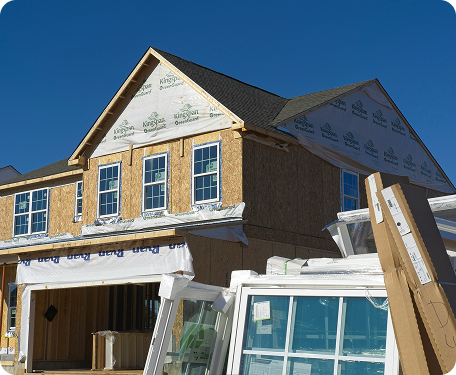
General Contractor Insurance for Multi-Trade Projects
Additional General Contractor Insurance Coverage Options
As your general contracting business expands, these additional coverage types merit careful consideration beyond your core insurance portfolio:
Tools & Equipment Coverage
(Inland Marine Policy)
Covers tools and equipment onsite and in transit. For $15k-$50k coverage, expect $1,500-$5,000+ annually. Rates depend on equipment value, use, and storage location.

Contract and License Bonds
Guarantees contract fulfillment. Limits vary by location and project ($10,000-$500,000+). Premium: 1-3% of bond amount. Higher rates apply for low credit scores. California requires contractors to carry a $25,000 contractor bond to operate independently. Verify your compliance with all local and project mandates.

Commercial Auto Coverage
Covers business vehicles. Annual premiums: $1,000-$4,000 per vehicle, with $500k-$1M limits. Rates vary based on fleet size, vehicle types, and driver records.
Contractor License Bonds
These financial guarantees demonstrate your commitment to quality workmanship while satisfying state licensing boards. Bond requirements commonly range $5,000-$25,000, with annual premiums representing 1-3% of the bond amount. Your credit profile significantly influences pricing.
Quote Summary by Revenue Level
Bond Required
Top-Tier Credit
Standard Credit
Challenged Credit
$5,000
$50
$100
$150 – $400
$10,000
$100
$200
$300 – $800
$15,000
$150
$300
$450 – $1,200
$20,000
$200
$400
$600 – $1,700
$25,000
$250
$500
$750 – $2,500
Regulations vary dramatically – California general contractors need $25,000 bonds while Texas imposes no blanket requirement.

Commercial Property and Business Personal Property
Protects buildings and offices against damage, theft, and disasters. Annual premiums: $2,000-$20,000+, based on property value, location, and construction type.

Builder’s Risk Insurance
Protects ongoing construction projects. Premium: 0.15-0.75%+ of project value. Costs vary with project value, duration, and complexity.

Excess Liability / Umbrella Coverage
Provides extra liability coverage. $1M limits costs $1,000-$2,000+ annually, Larger construction companies can explore $3M+ limits. Rates vary with company size, services, and claims history.
Frequently Asked Questions
What type of insurance should a contractor have?
You need general liability (GL) for property damage and injuries, plus workers’ comp if you have employees. Add commercial auto, inland marine for tools (covers theft – trust me, it sucks losing $15k in equipment), and completed ops coverage. Most contractors start with $1M/$2M GL limits running 1-3% of revenue.
How much does a $1,000,000 liability insurance policy cost?
For a $1M/$2M general liability policy, you’re looking at 0.9-2.2% of annual revenue. If you’re doing $500k/year, expect $4,780-$7,550. At $1M revenue, it’s $8,670-$13,000. Use class codes 91340 for residential or 91342 for commercial work.
How do I insure myself as a contractor?
Start with general liability using your specific class codes (91340/91342/915XX series), add inland marine for tools, and E&O for workmanship claims. If solo, skip workers’ comp but get it immediately when hiring. Yeah, premiums hit you for 1-3% of revenue, but beats losing everything in one lawsuit.
How much is general contractor insurance per month?
Monthly GL costs run $400-$1,100 for contractors doing $500k annually, or $720-$1,500 at $1M revenue. Add workers’ comp at $2-$17 per $100 payroll (code 5403 for commercial, 5645 for residential). Total monthly insurance often hits $800-$2,500 depending on your state and subcontractor percentage.
What is the difference between general contractors insurance and trade contractor insurance?
General contractors need broader coverage with higher limits to oversee entire projects and multiple subcontractors. Trade contractors require specialized coverage focused on their specific work (electrical, plumbing, etc.). GCs typically need comprehensive general liability, workers compensation, bonds, and project-specific policies, while trade contractors need targeted coverage for their specialty. Work with an agent experienced in contractor insurance to find appropriate coverage based on your scope of work.
What is the difference between bonding and insurance for contractors?
Insurance protects against accidents and injuries, while bonds guarantee project completion and payment obligations. Insurance claims are paid by carriers with no repayment required, but bond claims must be repaid to the surety company. Performance bonds ensure project completion, and payment bonds guarantee subcontractor payment. Contractors should maintain both insurance for business protection and bonds for client assurance.
Does contractors insurance cover subcontractors?
No. Contractors insurance typically does not cover subcontractors hired by a business.
Subcontractor Insurance Requirements – It’s important to verify subcontractors have their own general liability, workers’ comp, and professional liability coverage that matches your coverage in limits and has you as an additional insured. Without proof of adequate insurance, you’re liable for their incidents.
Subcontractor Exclusions – It’s worth highlighting that the CG 2294 exclusion removes coverage for damage caused by subcontractors’ faulty work. Without it, your insurance would typically cover damages from subcontractor negligence. For example, if a subcontractor’s faulty wiring causes a fire, this exclusion means your insurance won’t cover the damage under “products and completed operations.” Review policies carefully to avoid this and similar exclusions that limit coverage.